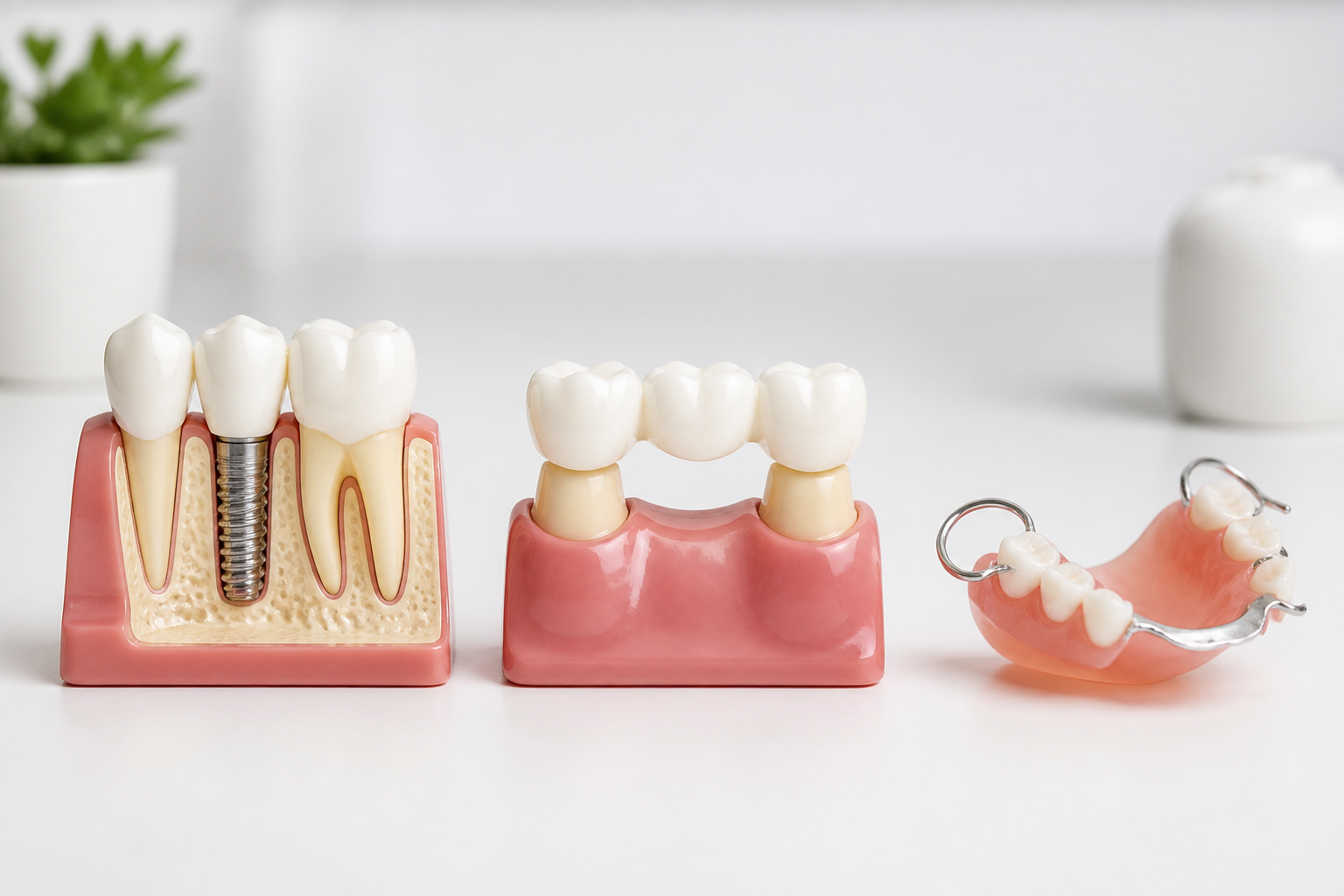
When you lose a tooth — or need one extracted — you’re usually presented with three main options: a dental implant, a bridge, or a denture. Each has genuine advantages and genuine drawbacks. The right choice depends on your specific situation, not on which option a practice happens to promote most heavily.
Here’s a straightforward comparison to help you understand what’s involved with each, so you can have a more informed conversation with your dentist.
The quick comparison
| Dental Implant | Bridge | Denture | |
|---|---|---|---|
| What it is | Titanium post surgically placed in the jawbone, topped with a crown | False tooth attached to crowns cemented onto adjacent teeth | Removable prosthetic — partial (some teeth) or full (all teeth) |
| Longevity | 15–25+ years, often lifetime with proper care | 10–15 years typically | 5–10 years before reline or replacement |
| Approximate cost (single tooth) | $3,000–$6,500 | $2,500–$5,000 | $500–$2,500 (partial) |
| Affects adjacent teeth? | No | Yes — neighbouring teeth are filed down for crowns | Partial dentures clasp onto adjacent teeth |
| Bone preservation | Yes — stimulates the jawbone | No — bone loss continues under the false tooth | No — bone loss continues |
| Feels like a natural tooth? | Closest to natural | Reasonably close | Less natural, can feel bulky |
| Surgery required? | Yes | No | No |
| Treatment timeline | 3–6 months (including healing) | 2–3 weeks | 2–4 weeks |
Dental implants — when they make sense
Dental implants are the closest thing to replacing a natural tooth. The titanium post integrates with your jawbone over several months, creating a stable foundation for a crown that looks, feels, and functions like a real tooth. You brush it, floss it, and forget about it.
The main advantages are longevity and independence — an implant doesn’t rely on neighbouring teeth for support, and it’s the only option that prevents the bone loss that naturally occurs when a tooth is missing.
The downsides are cost (implants are the most expensive option upfront), the need for surgery, and the longer treatment timeline. You also need adequate bone volume in the jaw — if bone has already been lost, a bone graft may be needed first, which adds time and cost.
Implants tend to make the most sense when you’re replacing one or two teeth, the adjacent teeth are healthy (so you’d rather not file them down for a bridge), and you want a long-term solution that you don’t have to think about.
Bridges — when they make sense
A dental bridge literally bridges the gap left by a missing tooth. The false tooth (called a pontic) is fused between two crowns that sit on the teeth on either side of the gap.
Bridges are a solid option when the adjacent teeth already have large fillings or crowns and would benefit from being crowned anyway. In that scenario, you’re addressing two problems at once. They’re also a good choice for patients who aren’t suitable candidates for implant surgery or who prefer to avoid a surgical procedure.
The main drawback is that healthy adjacent teeth must be permanently altered — filed down to accommodate the supporting crowns. Once that enamel is removed, those teeth will always need crowns. The bridge also doesn’t prevent bone loss in the area where the tooth is missing, and if one of the supporting teeth develops a problem down the line, the entire bridge may need to be replaced.
Cost sits in the middle — less than an implant, more than a denture.
Dentures — when they make sense
Dentures are the most affordable and least invasive option. A partial denture replaces one or several missing teeth and clips onto your remaining teeth. A full denture replaces all teeth in an arch.
Modern dentures are significantly better than what your grandparents wore. Materials are more natural-looking, fit can be quite precise, and for many patients, a well-made partial denture is a perfectly functional solution — especially when multiple teeth are missing and implants would be prohibitively expensive.
The honest downsides: dentures are removable, which some people find inconvenient or self-conscious about. They can affect speech and taste (full dentures cover the palate). They need periodic relining as the jawbone changes shape over time. And they don’t prevent bone loss.
Dentures make the most sense when cost is the primary concern, when multiple teeth need replacing, when surgery isn’t an option due to health reasons, or as an interim solution while saving for implants.
There’s no universally “best” option
Anyone who tells you one option is always the best isn’t giving you the full picture. A 30-year-old who loses a single front tooth in an accident has very different considerations from a 75-year-old who needs to replace several back teeth.
The factors that matter most are:
- How many teeth are missing and where they are
- The condition of your remaining teeth — healthy teeth shouldn’t be sacrificed unnecessarily for a bridge
- Your jawbone health — adequate bone is needed for implants
- Your overall health — some medical conditions or medications affect implant healing
- Your budget — both upfront and long-term (implants cost more initially but last longer)
- Your preferences — some people simply don’t want surgery, and that’s a valid consideration
What we recommend
Come in for a consultation and we’ll assess your specific situation — the gap, the surrounding teeth, your bone health, your medical history. We’ll explain which options are realistic for you and give you honest advice about what we’d choose if it were our own mouth.
At Smile Spot Mawson Lakes, we offer dental implants, bridges, and dentures as part of our general dentistry services. We’ll walk you through the pros and cons as they apply to your case — not as a generic sales pitch. We also offer DentiCare interest-free payment plans to help spread the cost of larger treatments. We’re a Bupa Members First Platinum provider and a preferred provider for NIB, CBHS, and smile.com.au — plus we accept all other major health funds, including HCF, with claims processed on the spot through HICAPS.
We see patients from Mawson Lakes, Parafield Gardens, Salisbury, Paralowie, Ingle Farm, Golden Grove, and Para Hills. Evening appointments are available Monday to Thursday until 7pm.
Book a consultation or call us on (08) 8258 0650.
Smile Spot Mawson Lakes — 1/3 Coventry Street, Mawson Lakes SA 5095.
Any surgical or invasive procedure carries risks. Before proceeding with treatment, you should seek a second opinion from an appropriately qualified health practitioner. Individual results may vary.